AI Receptionist vs Answering Service vs Hiring a Receptionist: Which Is Right for Your Trade Business?
AI receptionist, answering service or an in-house receptionist? How they compare on hours, cost, quality and emergencies for roofing and HVAC companies.
What's the difference between the three?
- AI receptionist: software that answers your business line with a natural voice. It works from what you tell it about your services, areas and prices, takes the caller's details and sends them to you. It never sleeps and can take many calls at the same time.
- Answering service: a company whose staff answer calls for many businesses. They follow a script, take messages and pass them on, and some can page your on-call technician. You're sharing their people with dozens of other clients.
- In-house receptionist: a person on your payroll who answers your phone, and usually does scheduling, dispatch, invoicing and paperwork too.
How do they compare side by side?
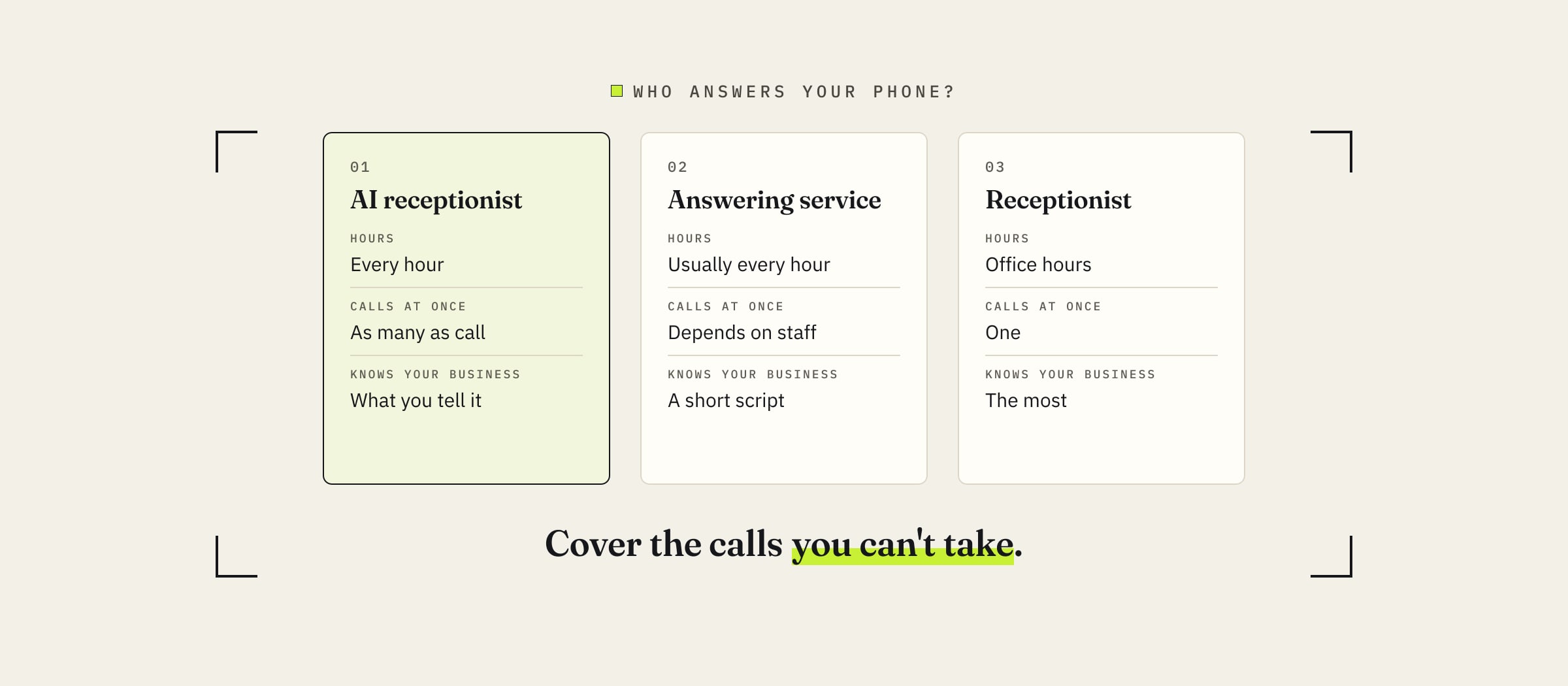
- Hours. AI receptionist: every hour, every day. Answering service: usually around the clock. In-house receptionist: office hours, minus lunch, sick days and holidays.
- Calls at the same time. AI receptionist: as many as come in. Answering service: depends on how many staff are free at that moment. In-house receptionist: one at a time.
- Cost. AI receptionist: the lowest, often tens to a few hundred dollars a month. Answering service: usually priced per minute, often several hundred dollars a month for a busy line. In-house receptionist: the highest, around $50,000 to $61,000 a year with benefits.
- Knows your business. AI receptionist: knows what you give it, and the same answer every time. Answering service: works from a short script and knows little about your trade. In-house receptionist: knows the most, and gets better over time.
- What you get after each call. AI receptionist: an instant written summary, often with a recording. Answering service: a message by text or email, detail varies. In-house receptionist: whatever they write down, or what they remember.
- Emergencies. AI receptionist: flags urgent calls straight away. Answering service: can often page your on-call tech. In-house receptionist: handles them well during the day, not at night.
- Caller experience. AI receptionist: fast and consistent; some callers would rather talk to a person. Answering service: a human voice, but they can't answer many questions. In-house receptionist: the warmest, when they're free to pick up.
For a full breakdown of prices, billing models and hidden fees, see our guide to how much an AI receptionist costs for roofers and HVAC companies.
When is an AI receptionist the best choice?
- You and your crew are on jobs during the day and calls go to voicemail.
- You get calls at night and on weekends: leaks, storm damage, no heat, no cooling.
- Your calls come in bursts, after storms, in heat waves or when an ad goes out.
- You want every call written down in one place, not scraps of paper and voicemails.
- You can't justify a full-time salary just to answer the phone.
When is an answering service the better choice?
- Your customers strongly expect a human voice, every time.
- You need someone to call or page an on-call technician in the middle of the night and stay on it until they respond.
- Your calls need a lot of judgement that's hard to write down as simple rules.
The trade-offs: you pay by the minute, the person answering is handling calls for many other businesses, and the message you get is only as good as their notes.
When should you hire a receptionist?
Hire when the job is bigger than answering the phone. If you need someone to run the schedule, dispatch technicians, chase invoices, order parts and greet customers at the office, a good office manager or receptionist is worth every dollar. An AI receptionist doesn't replace that person. It covers the hours and the overflow they can't.
Can you use more than one?
Yes, and many businesses do. Here are three common set-ups:
- Office staff by day, AI receptionist after hours. Your phone forwards to the AI receptionist when the office closes, so evening and weekend calls are still answered and written up for the morning.
- AI receptionist for overflow. When your receptionist is on another call or at lunch, the next call goes to the AI receptionist instead of voicemail.
- AI receptionist first, person for emergencies. The AI receptionist answers every call, and urgent ones go straight to whoever is on call so they can phone the customer back fast.
How do you decide?
- When do you miss calls? Check your call log for after-hours, weekend and busy-day gaps.
- How many calls do you get a month, and how long are they?
- What does a missed job cost you? Use your average job value and close rate.
- Do you need someone answering the phone, or someone running the office? Those are different jobs.
- How important is a human voice to your customers, compared with being answered straight away?
Where does Jane fit?
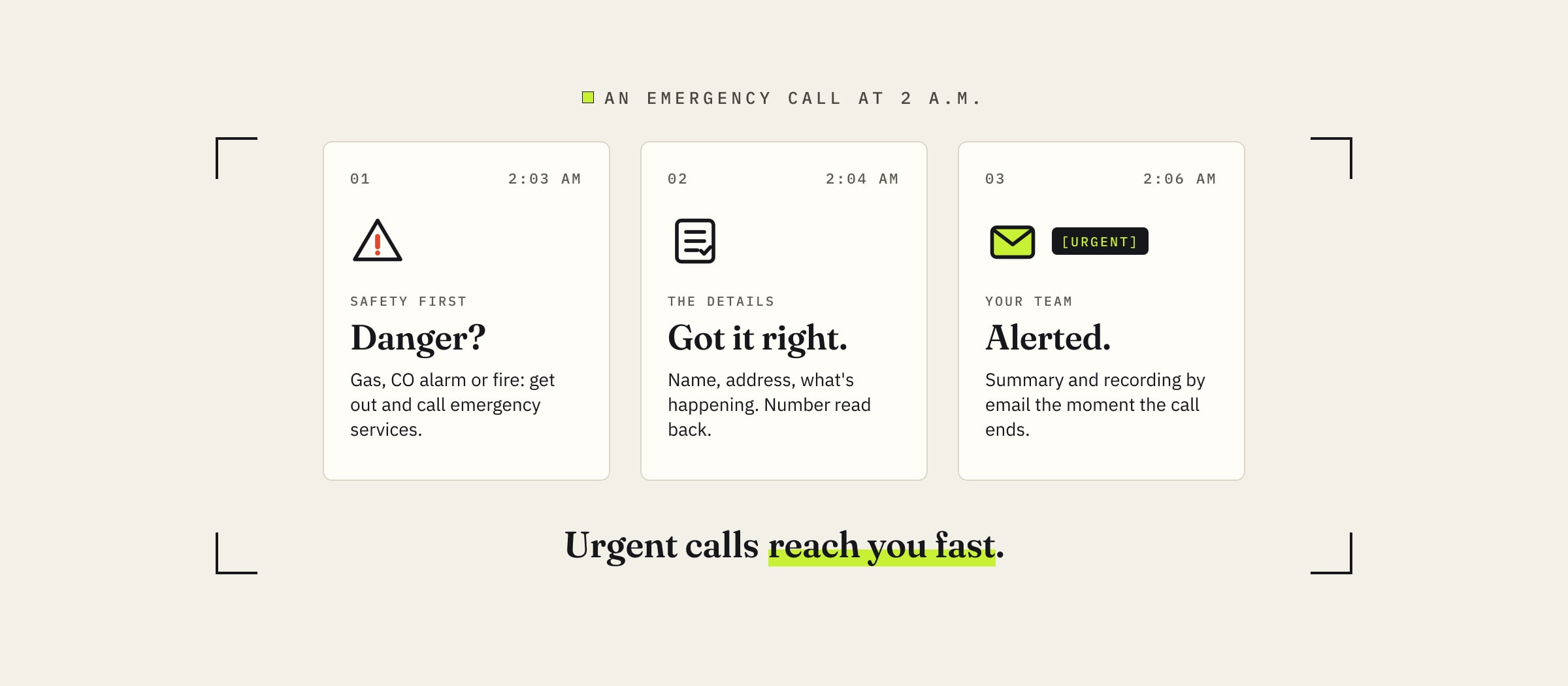
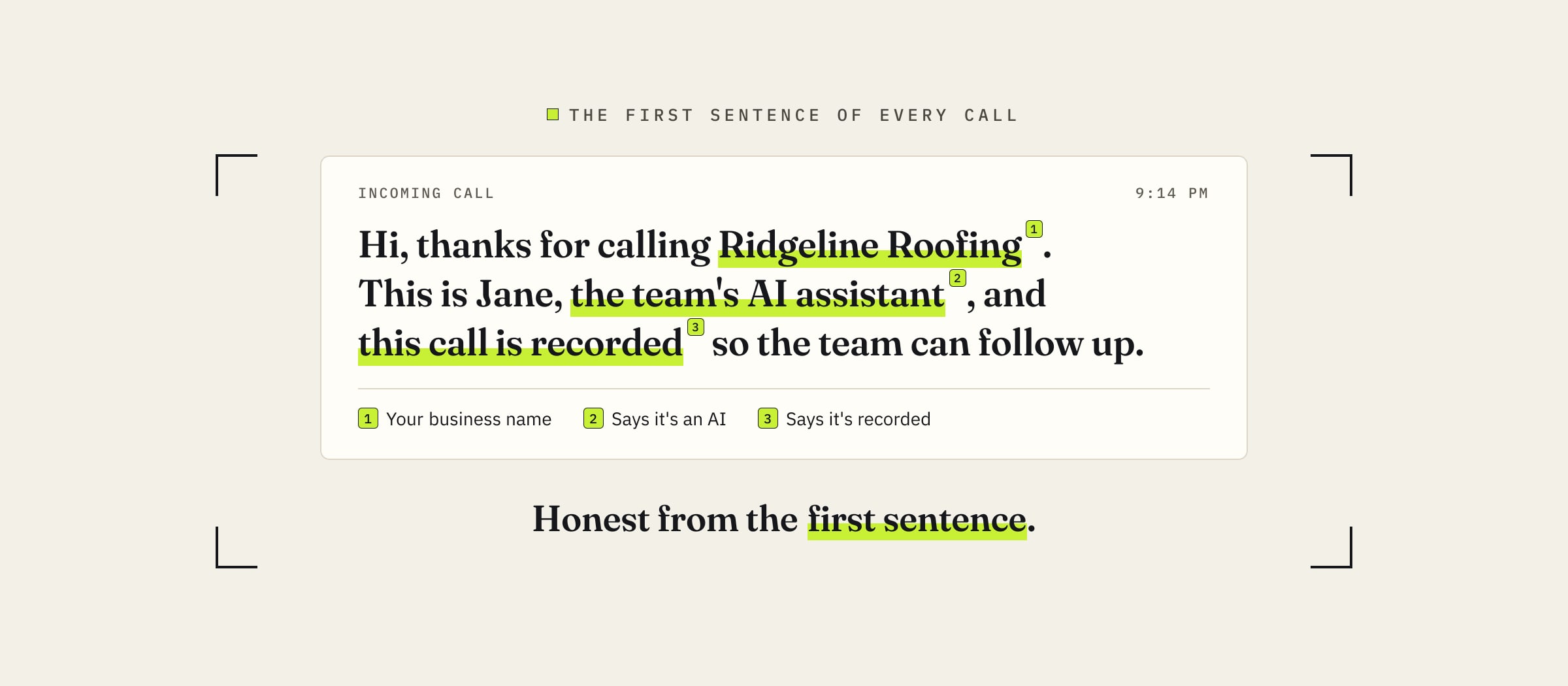
Jane is the AI receptionist we set up and run for trade businesses. She answers every call in your business name, tells callers she's an AI assistant and that the call is recorded, answers simple questions from your services, areas and starting prices, and takes the caller's name, need and call-back number. You get an email with her summary and the recording as soon as the call ends, and urgent jobs say so in the subject line.
To be clear about what she doesn't do: she doesn't put callers through to a technician during the call, and she doesn't run your schedule or dispatch. She makes sure every caller is answered and every job reaches you fast, so you or your office can take it from there. That's why she works well alongside office staff as well as on her own.
Jane comes with every SiteScan plan. On her own, our Front Desk plan (Jane plus your lead dashboard) is from $297 a month plus a one-time $500 setup (£239 a month plus £395 in the UK), month to month.
Frequently asked questions
Is an AI receptionist better than an answering service?
For most small trade businesses, yes, on speed, cost and consistency: it answers instantly, any hour, many calls at once, and sends a written summary straight away. An answering service is better if your callers insist on a human voice or you need someone to page an on-call technician.
Should I hire a receptionist or use an AI receptionist?
If you need someone to run the schedule, dispatch and paperwork, hire a person. If the problem is missed calls after hours, on busy days or while you're on a job, an AI receptionist solves it for far less. Many businesses use both.
Can an AI receptionist replace my office manager?
No. An AI receptionist answers calls and passes the details on. It doesn't run your schedule, dispatch technicians or handle paperwork. It frees your office manager from the phone and covers the hours they aren't there.
Do customers mind talking to an AI receptionist?
Most callers mainly want a fast, useful answer and a call back. Being upfront that it's an AI, as Jane is at the start of every call, avoids callers feeling tricked. Some still prefer a person, which is why urgent and complicated calls should reach your team quickly.
Can I use an AI receptionist only after hours?
Yes. You can forward your calls to an AI receptionist only when the office is closed, only when the line is busy, or after a set number of rings, and keep answering yourself the rest of the time.