What Happens to Missed Calls at Your Roofing or HVAC Company?
Most callers who reach voicemail call the next contractor instead. What a missed call really costs a roofing or HVAC company, and three ways to stop it.
Why do roofing and HVAC companies miss so many calls?
Because the people who answer the phone are also the people doing the work. You're on a roof, in an attic, under a condenser or driving between jobs. The office closes at five, but water still comes through ceilings at nine at night and furnaces still quit at two in the morning.
Calls also arrive in bursts. The first hot week of summer, the first freeze, the morning after a hailstorm: that's when your phone rings the most, and it's when your team is busiest. A shop that answers every call on a quiet Tuesday can still miss half of them on a storm Monday.
How often does it happen? CallRail's January 2025 small-business benchmark put the average missed-call rate for home services at 14%, about 1 call in 7. Estimates for busy HVAC, plumbing, electrical and roofing companies run higher, closer to 1 in 4. Your own phone system can tell you your real number, and it's worth checking.
What does the caller do when nobody answers?
Think about who's calling. Someone with water dripping into a bedroom, or a family with no heat, isn't shopping around for the best brochure. They want someone to pick up. If you don't, they go back to Google and call the next name on the list.
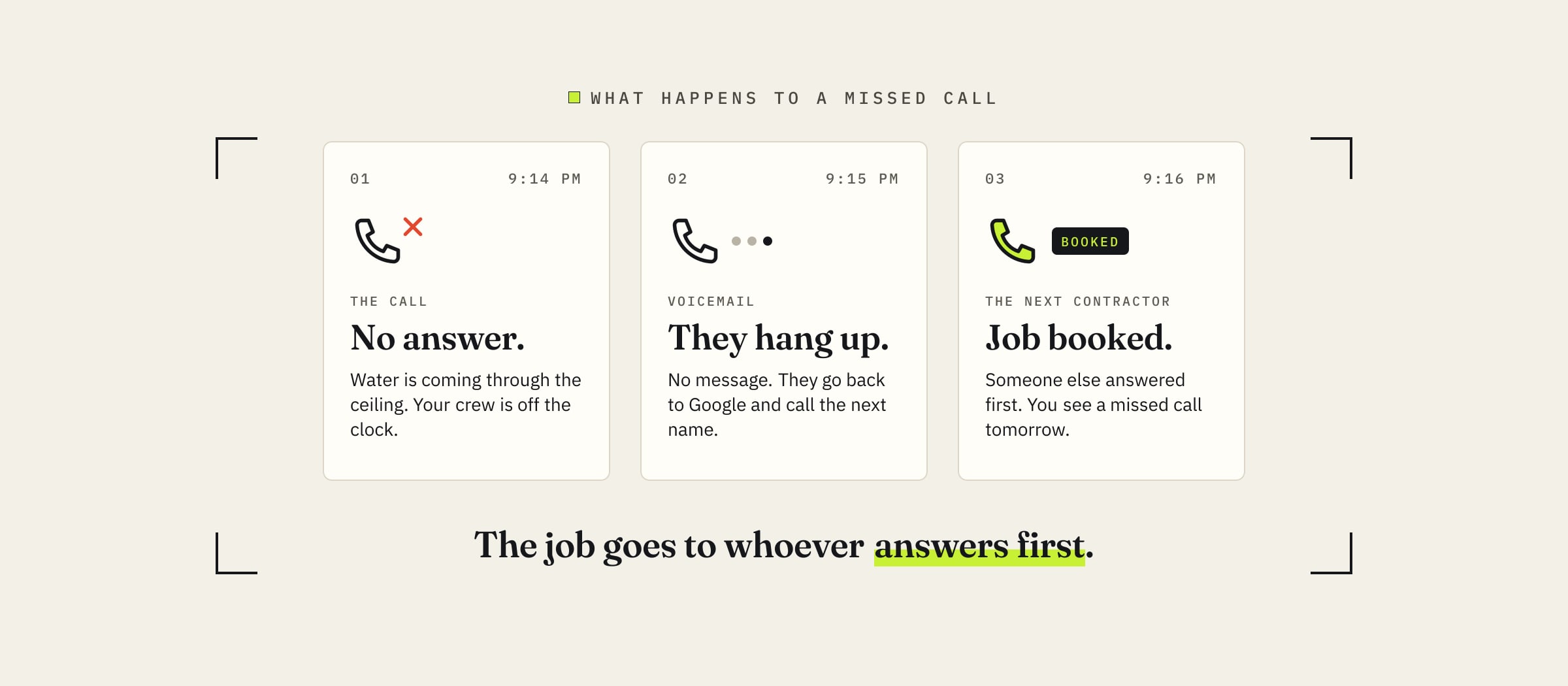
- They hear your voicemail greeting. Many people hang up here without leaving a message.
- If they do leave one, it's often rushed: half a name, a number said too fast, no address, no idea how urgent it is.
- They call the next company. If that company answers, the job is usually gone before you see the missed call.
- When you call back an hour or a day later, they've often booked someone else, or they don't pick up because they don't recognise your number.
Speed matters more than most owners expect. A widely quoted study by Harris Interactive found that calling a lead back within five minutes made you about 21 times more likely to reach them than calling back at 30 minutes. Yet a 2026 ServiceTitan survey found only about half of contractors respond to new leads within the first hour.
How much is one missed call worth to a roofer or HVAC company?
Not every missed call is a job. Some are suppliers, spam or existing customers. But the real ones are worth far more in the trades than in most businesses, because a single job is large. A roof replacement or a new HVAC system is thousands of dollars, and a happy customer comes back for years of maintenance and tells their neighbours.
You don't need an industry average. You can work out your own number in two minutes:
- Missed calls a month: check your phone system or carrier's call log.
- Share that are real potential jobs: leave out spam, suppliers and existing customers. Half is a cautious guess if you don't know.
- Your close rate: out of real enquiries you speak to, how many become paid jobs?
- Your average job value: what a typical new customer is worth on the first job.
- Multiply them together. That's roughly the work you lose each month.
An example for a small roofing company: 20 missed calls a month, half of them real jobs, so 10. If the company normally closes 3 in 10 enquiries, that's 3 jobs. At an average of $6,000 each, that's about $18,000 of work a month going to someone else.
An example for a small HVAC company: 30 missed calls a month, 60% real, so 18. Closing 4 in 10 is about 7 jobs. Most are repairs, so take a cautious average of $500, and that's about $3,500 a month, before counting the one caller who needed a whole new system or the maintenance plans those customers would have bought.
These are examples, not promises. Plug in your own numbers. Even if your result is a quarter of these figures, it's usually more than the cost of answering every call.
Why is the cost higher after hours and in peak season?
The calls you're most likely to miss are often the most valuable. Night and weekend calls skew toward emergencies: active leaks, storm damage, no heat, no cooling. Those customers book fast, rarely haggle, and remember who helped them. Peak-season calls are similar: everyone in town needs a contractor at once, so the first company to answer wins the job, and often the replacement quote that follows the repair.
What are the ways to stop losing missed calls?
There are three common fixes. Each one is better than doing nothing.
- A better voicemail. Free and quick. Say your business name, ask for their name, address, number and whether it's urgent, and say when you'll call back. It still relies on people choosing to leave a message, and many won't.
- A human answering service. A live person answers, takes a message and passes it on. Callers like hearing a person. Costs usually run from under a dollar to several dollars a minute, and the person answering won't know your services in detail.
- An AI receptionist. Software answers every call straight away, any hour, as many at once as come in. A good one answers simple questions from your own information, takes the caller's details, flags emergencies, and sends you everything as soon as the call ends. It costs less than a person for most call volumes, but the setup matters: it's only as good as what you tell it.
How does an AI receptionist handle a call you'd have missed?
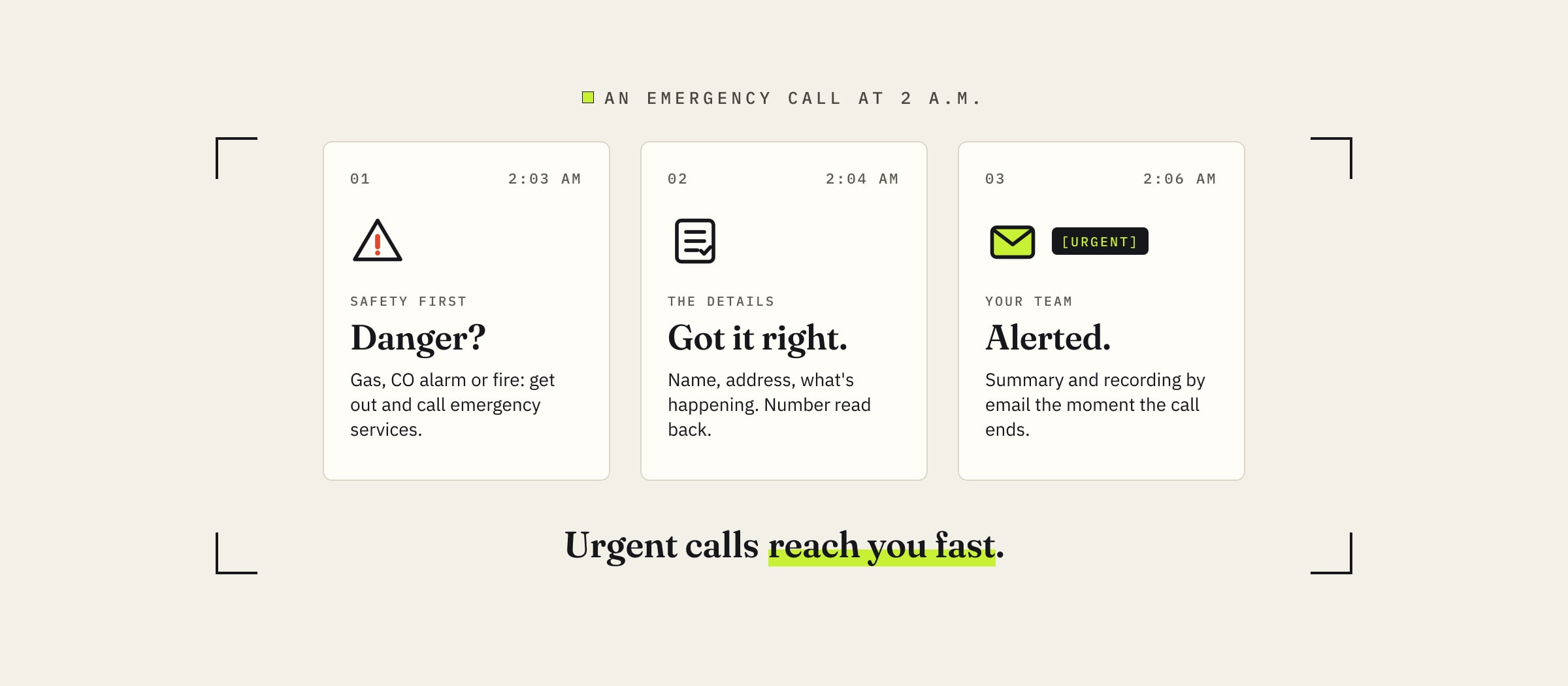
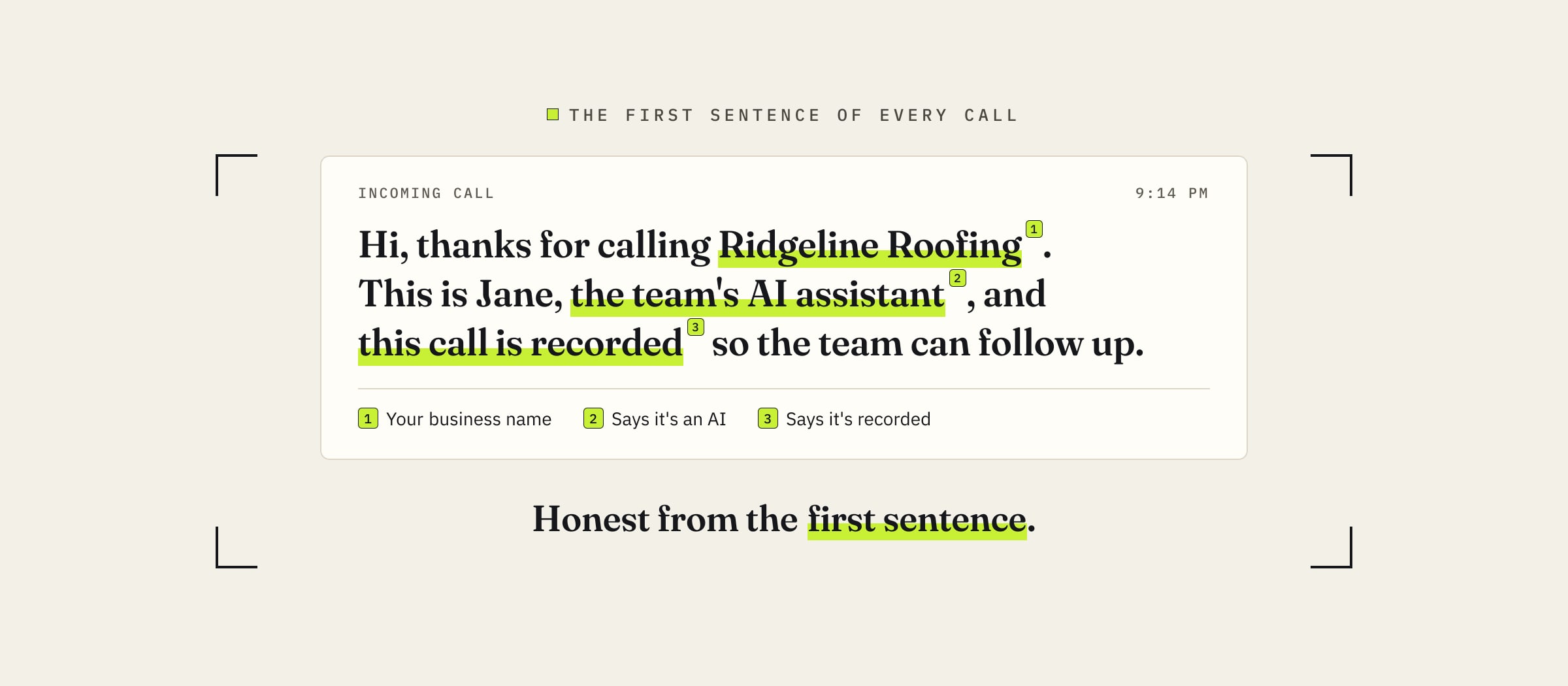
Here's how Jane, the AI receptionist we set up for trade businesses, handles a call. She picks up straight away with your business name, says she's an AI assistant and that the call is recorded. She works out what the caller needs, answers simple questions from your services, areas and starting prices, and never makes up a quote. She takes their name, what they need and the best number to call back, and reads the number back so it's right.
As soon as the call ends, you get an email with her summary, the confirmed number and the recording. Urgent jobs say so in the subject line. Every call is also saved as a lead in your dashboard, so nothing gets lost in a voicemail box. When you call back, you already know who it is and what the job is.
What should you do this week?
- Pull last month's call log and count the missed calls, including after hours and weekends.
- Run the five-step sum above with your own close rate and job value.
- Call your own number after hours and listen as a customer would. Would you leave a message?
- Decide how you'll answer the calls you can't take yourself: a better voicemail, an answering service or an AI receptionist.
Frequently asked questions
What percentage of calls do contractors miss?
CallRail's January 2025 benchmark put the average missed-call rate for home services at about 14%, roughly 1 in 7 calls. Estimates for busy HVAC, plumbing, electrical and roofing companies are higher, around 1 in 4. Check your own phone system's call log for your real figure.
Do customers leave voicemails for contractors?
Many don't. Someone with a leaking roof or a broken furnace usually hangs up and calls the next company instead. Those who do leave a message often leave it incomplete, which makes the call-back harder.
How fast should I call back a missed call?
As fast as you can, ideally within five minutes. A widely quoted Harris Interactive study found you are about 21 times more likely to reach a lead at five minutes than at 30 minutes. After an hour, many callers have already booked someone else.
Is an answering service or an AI receptionist better for a trade business?
An answering service gives callers a human voice but costs more per minute and won't know your services in detail. An AI receptionist answers every call instantly, any hour, can handle several calls at once and sends you the details straight away, usually for less. Many businesses pick based on call volume and budget.
Will callers know they're talking to an AI?
They should. Jane, SiteScan's AI receptionist, tells every caller at the start that she's an AI assistant and that the call is recorded, and never claims to be a person. Being upfront builds trust and keeps you on the right side of recording-consent rules.